
 EN
EN



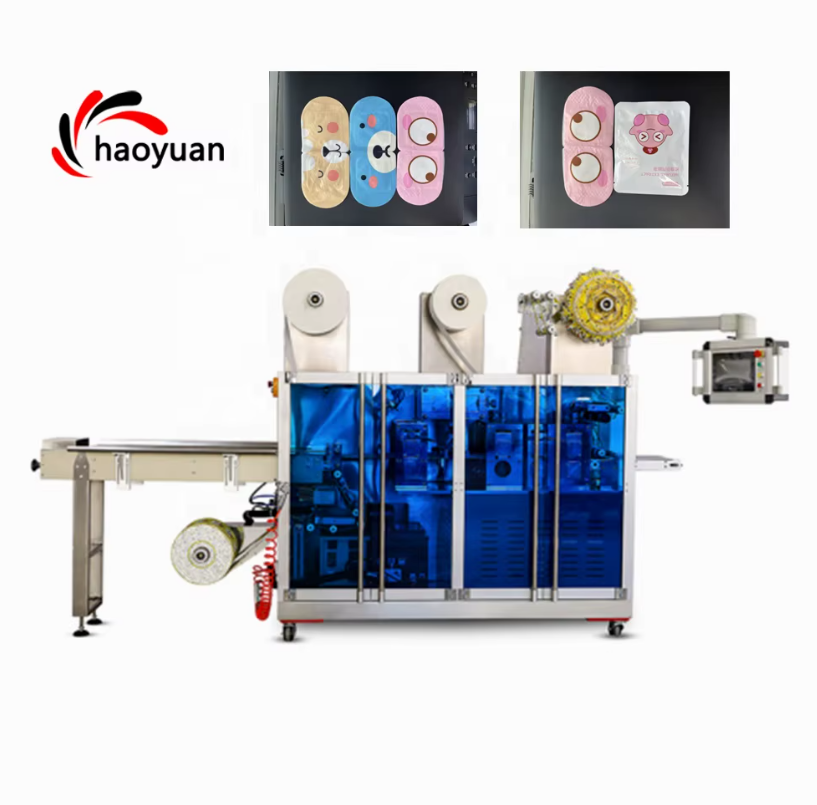
Raw Material Preparation Sets the Baseline
A steam eye mask production line does not start with the sealing machine. It starts with the nonwoven fabric and the heating powder. The outer layer is a soft nonwoven material that has to be unwound at a stable tension. If the tension drifts, the cutting and sealing stations have to compensate, and that usually creates more rejects. The heating powder is a mix of iron powder, activated carbon, salt, and moisture. It must be blended under controlled humidity because too much moisture starts the oxidation reaction too early. Many plants use a powder mixer with a dehumidifier connected to the feed area. From there, the mixed powder moves to a hopper above the dosing unit.
The Heating Element Filling Station Is the Critical Point
The filling station is where most quality problems begin. Each eye mask needs a precise dose of heating powder, usually from a volumetric or auger filler. A variation of a few tenths of a gram can shift the peak temperature by several degrees. The filler also has to keep powder away from the seal area, because stray powder causes weak seals. The station often includes a vibratory tray or leveling mechanism to keep the powder bed uniform. In one project at a contract packaging facility in Zhejiang, the production team noticed that temperature peaks were drifting between batches. The root cause was a slightly bent leveling blade on the auger filler, which changed the fill density without triggering any alarm. Replacing the blade restored consistent heating performance.
Sealing Equipment Must Handle Delicate Nonwoven Layers
After filling, the top and bottom nonwoven layers have to be sealed without damaging the material. Heat sealing works well when the fabric has a thermoplastic component, but the temperature window is narrow. Ultrasonic sealing uses high-frequency vibration to fuse the layers locally, which can be gentler on thin nonwovens and avoids a heated tool surface. The sealing station also forms the individual eye mask shape, including the ear loops or side notches if the design uses them. The tooling must be changed whenever the mask shape changes, so a quick-change design matters a lot for contract manufacturers.
Cutting and Shaping Stations Keep the Geometry Consistent
Once the continuous web is sealed, it moves to cutting and shaping. Rotary die cutters or guillotine cutters separate the masks from the web. The cut edge has to align with the seal line, or the mask will have a weak border. The shaping station also punches the ear loops or creates the fold line that lets the mask sit over the eyes. A steam eye mask production line usually includes a registration system with sensors that read a printed mark or the seal pattern to keep the cut position accurate. Small registration errors are easy to ignore at low speed, but they become expensive when the line runs continuously.
Inspection and Rejection Systems Catch Hidden Defects
A well-equipped line has more than filling and sealing. Checkweighers verify the fill weight after sealing, and metal detectors or X-ray systems can catch foreign material before the mask enters the retail package. Vision systems check the seal width, the presence of the ear loops, and the print quality on the outer layer. The Japanese Industrial Standard JIS S 4100 for disposable chemical warmers provides a useful reference for temperature uniformity and surface temperature limits. A practical line uses a sampling plan based on ISO 2859-1 or a similar standard to decide how many masks to pull from each batch for temperature testing. The goal is not to test every single mask, but to catch process shifts before they become full-batch failures. Operators rarely catch every bad mask by eye at high speed. Automated inspection is the only practical way to keep the reject rate under control.
The table below compares a basic semi-automatic setup with a fully integrated line across key stations.
| Line Section | Basic Semi-Automatic Setup | Fully Automatic Integrated Line |
|---|---|---|
| Powder filling control | Manual tray loading, periodic weight checks | Auger or volumetric filler with automatic feedback |
| Sealing method | Single heat-seal jaw | Ultrasonic or multi-zone heat sealing |
| Cut registration | Manual alignment | Sensor-based continuous registration |
| Inspection level | Visual check and random weighing | Inline checkweigher, vision, metal detection |
| Packaging output | Batch collection, offline pouch packing | Inline pouch filling, date coding, case packing |
Packaging Automation Turns Bulk Masks into Retail Units
The final section of a steam eye mask production line converts loose masks into shelf-ready units. The masks are usually stacked, inserted into a foil pouch to preserve freshness, and sealed. A horizontal flow wrapper or a premade pouch filler can handle this step. The pouch film blocks oxygen and moisture, because the heating powder loses activity if it is exposed to air for too long. After pouch sealing, the line can include a checkweigher, a date coder, and a case packer. This packaging section is where a company like Haoyuan tends to add the most value, because the same motion control, sealing, and inspection discipline that works on eye masks also transfers to pouch packaging, cartoning, and shrink wrapping. When the packaging machines are designed with quick changeover and gentle product handling in mind, the whole line runs more smoothly and the finished masks reach the market with fewer rejects. A line that can switch between mask sizes without hours of downtime gives a manufacturer a real advantage.
Table of Contents
- Raw Material Preparation Sets the Baseline
- The Heating Element Filling Station Is the Critical Point
- Sealing Equipment Must Handle Delicate Nonwoven Layers
- Cutting and Shaping Stations Keep the Geometry Consistent
- Inspection and Rejection Systems Catch Hidden Defects
- Packaging Automation Turns Bulk Masks into Retail Units